
Where does Halloween come from, and why is it full of ghosts? This reading goes from the Celtic festival of Samhain to trick-or-treating in America – with strange customs from around the world, spooky ghost facts, comprehension questions with answers and, to finish, a slime recipe for a Halloween science lesson.
1. The origins of Halloween
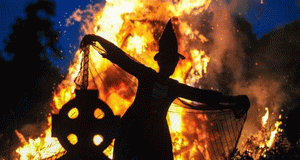
Samhain and All Hallows’ Eve
Thousands of years ago people believed that at the end of summer evil spirits stole the sun and brought the darkness of winter. 31 October was thought to be the most dangerous night of the year.
In ancient Britain and France the Celts celebrated a festival called Samhain (pronounced sow-in). They believed that on this night spirits, witches and goblins wandered the land and caused mischief. To protect themselves, people lit huge bonfires and wore costumes made from animal skins to hide from the spirits.
Later Samhain mixed with the Roman festival of Feralia, which honoured the dead. Christians then introduced All Saints’ Day on 1 November, and the evening before it became All Hallows’ Eve – then “Hallowe’en”, and finally just “Halloween”.
2. Strange Halloween facts around the world
From bonfires to fortune bread
- The word bonfire comes from “bone” and “fire” – people once burned animal bones to scare off spirits.
- In England Halloween was once called Nutcrack Night or Snap Apple Night.
- In Japan people honour their ancestors at Obon, usually in mid-August.
- The first jack-o’-lanterns in Ireland and Scotland were carved from turnips.
- An old German word for a nightmare means “goblin pressure”.
- Irish families bake barmbrack with a ring inside – whoever finds it will marry soon.
- In Mexico bakeries sell pan de muerto, “bread of the dead”, for the Day of the Dead.
- In France families bring flowers to the graves of relatives on 1 November.
3. Why do ghosts haunt Halloween?
Welcome home – or else
Ghosts were once seen as peaceful visitors: many people believed the spirits of their ancestors came home on Halloween. Bonfires on the hills showed them the way, and they were welcomed with food and drink.
But if the spirits were not treated well, they could become angry and steal animals or even children. These legends led to the tradition of giving treats to avoid tricks.
Noisy ghosts that move furniture and make a mess are called poltergeists.
4. Spooky ghost facts
- Children and animals are said to notice ghosts first.
- A blue candle flame is believed to mean a ghost is near.
- A candle that goes out by itself may mean a ghost is in the room.
- Ghosts leave no shadows or footprints.
- A mirror on the door is said to keep ghosts away.
- Throw a key at a ghost and it will vanish – or so they say.
- Red clothes and bright lights protect you from spirits.
- Turning your pocket inside out is an old way to scare off a ghost.
5. Halloween traditions in America
From Europe to trick-or-treat
“Halloween” means “holy evening” – the night before All Saints’ Day. Long before Christianity, people believed 31 October was the night when spirits returned, and they made noise, wore scary costumes and built fires to frighten them away.
European immigrants brought these customs to the United States. The best known is the jack-o’-lantern: people carve a face into a pumpkin and put a candle inside to scare off ghosts.
Today Halloween is above all a children’s holiday. Kids dress up as ghosts, skeletons and monsters and go from house to house saying “Trick or treat!” Neighbours give them sweets or small gifts – or the children play a harmless trick.
- When is Halloween celebrated?
- Why did people wear scary costumes in the past?
- What was the Celtic festival called?
- Why did people give treats to the spirits?
- Who brought Halloween customs to the United States?
- What do people put inside a carved pumpkin, and why?
- What do children get when they say “Trick or treat”?
Show answers
- On 31 October, the night before All Saints’ Day.
- To hide from the spirits and to scare them away.
- Samhain.
- So that the spirits would not get angry and play tricks.
- European immigrants.
- A candle – to scare off ghosts.
- Sweets or small gifts.
A two-minute chemistry lesson that every class remembers. The glue contains a liquid polymer (polyvinyl acetate); borax links its long molecules together, and the runny glue turns into stretchy slime. The more you play with it, the thicker it gets.
What you need
- white liquid glue
- borax (sodium borate)
- water
- two bowls, a teaspoon and spoons for stirring
- cups and plastic bags
- food colouring (optional)
Steps
- Mix ¼ cup of glue with ¼ cup of water. Add food colouring if you like.
- In another bowl, dissolve ½ teaspoon of borax in ½ cup of water.
- Slowly pour the borax water into the glue, stirring all the time.
- When the slime forms, knead it with your hands until it is less sticky.
Safety: borax can irritate the skin and eyes, so an adult should measure and mix it, and everyone washes their hands after playing. Keep the slime in a plastic bag in the fridge – it stays fresh longer.
- Split the reading between five groups – each group reads one part and tells the others the three most surprising things.
- Use the ghost facts for a “Would you believe it?” discussion: which superstitions do students know from their own country?
- Make the slime at the end of the lesson and describe each step in English: First we mix… then we add…
Everything else for the holiday – games, worksheets, listening and videos – is in the Halloween section.