David Goes to School Activities – Free ESL Book Companion
Free interactive activities for David Goes to School by David Shannon – the back-to-school favorite about a boy who breaks every classroom rule. Nine no-prep games for young ESL learners (ages 5–8, Pre-A1 to A2): watch the story, then practice the present continuous, classroom commands, listening and speaking. They run on a smartboard, a tablet or in an online lesson, with no sign-up.
About the book
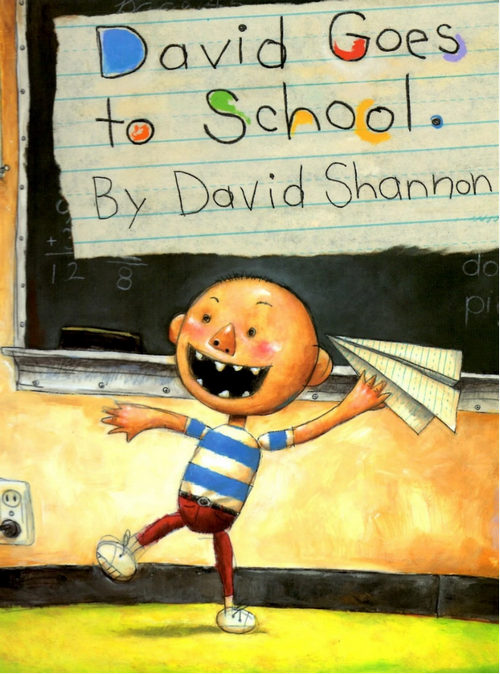
David Goes to School (1999) is the sequel to No, David! This time David takes his mischief to school: he arrives late, chews gum in class, shouts out answers, cuts in line, starts a food fight in the lunchroom and scribbles on his desk. Each page shows one thing David is doing and one short line from his teacher, so the story is easy to follow even for children who are just starting English. At the end David has to stay after school and clean the desks – and finally hears some praise.
That simple pattern is why the book works so well in an ESL classroom. Every picture answers the question “What is David doing?”, and every teacher line is a rule children hear at school every day: Sit down. Raise your hand. No running in the halls. It is a natural way to start the school year and agree on your own class rules.
What’s inside: 9 activities
- Story. An animated read-aloud of the book. Watch it first – you do not need a printed copy.
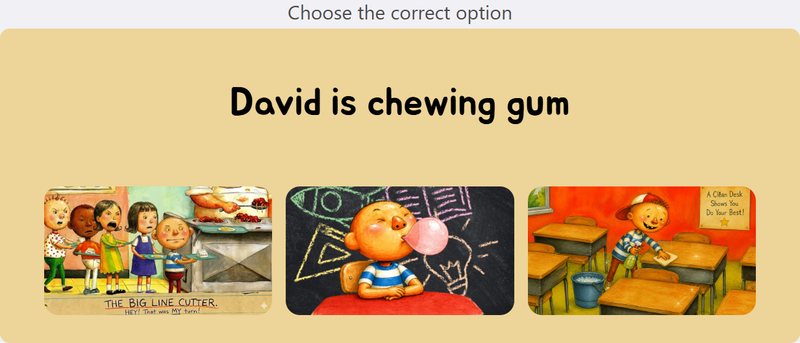
- What is David doing? 16 rounds: read a sentence such as “David is chewing gum” and choose the matching picture out of three.
- Listen and choose! The same 16 actions as a listening game: hear the sentence and tap the right picture as fast as you can.
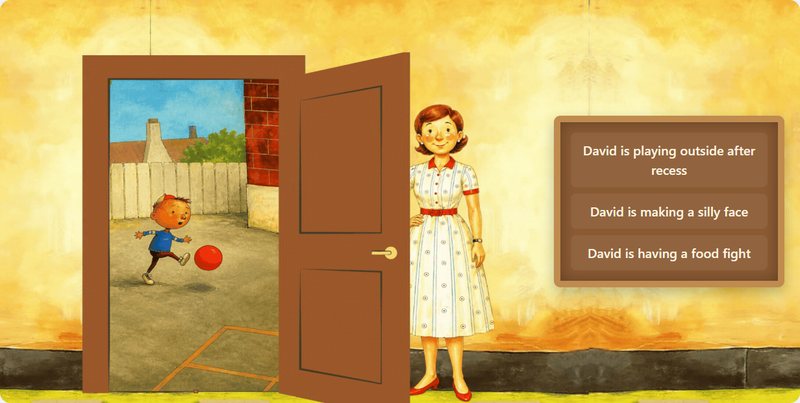
- Comprehension questions. 10 questions about the story with two pictures to choose from: what David did in the lunchroom and the library, what “tardy” means and what happened after school.
- Describe and react! 16 speaking cards. Say what David is doing, then tell him to stop: “Stop it, David! Sit down!”
- Caught in the act! A two-step game in 10 rounds: pick the sentence that shows what David is doing, then listen and choose what the teacher says.
- What does the teacher say? 10 listening rounds on classroom commands. Listen to what David is up to and choose the teacher’s words: Raise your hand, Recess is over, Don’t chew gum in class.
- Can you guess? 8 rounds that work the other way round: hear only the teacher’s reaction and guess what David is doing.
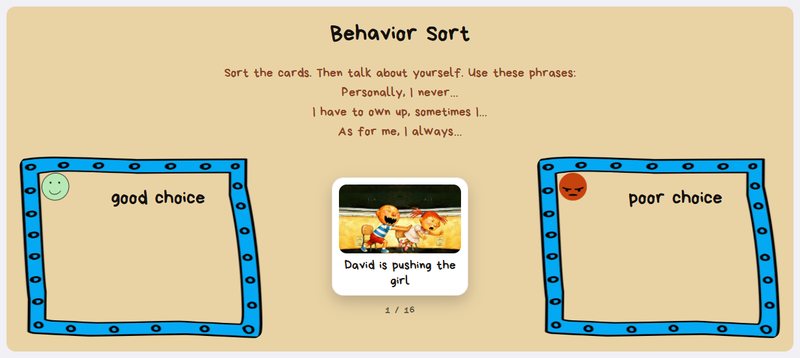
- Behavior Sort. Drag 16 cards into “good choice” and “poor choice”, then talk about yourself: “Personally, I never…”, “As for me, I always…”.
Language focus
- Grammar: the present continuous (He is running in the hall), imperatives for classroom rules (Sit down. Don’t chew gum in class.) and, for A1–A2, adverbs of frequency (always, sometimes, never).
- School actions: raise your hand, shout out the answer, cut in line, chew gum, throw a paper plane, make a silly face, look out the window, clean the desk.
- School words: classroom, desk, hall, lunchroom, library, recess, tardy.
A 40-minute lesson plan
- Warm-up, 5 min. Ask “What are the rules in our classroom?” and write three or four answers on the board.
- Story, 7 min. Watch the read-aloud together. Pause on two or three pages: “What is David doing? Is that OK?”
- Vocabulary, 8 min. Play What is David doing? on the board as a class, then Listen and choose! in pairs or teams.
- Comprehension, 5 min. Go through the comprehension questions; students answer out loud before anyone clicks.
- Listening, 7 min. What does the teacher say? or Caught in the act! Let students repeat the teacher’s line in a strict teacher voice – children enjoy playing the teacher.
- Speaking, 8 min. Behavior Sort, then each student says one true sentence about themselves: “I sometimes forget my pencil case.” With Pre-A1 learners, use Describe and react! instead.
Next lesson, use Can you guess? as a five-minute warm-up, or make a class rules poster together: “In our class we raise our hands. We don’t run in the halls.”